ne arıyorsun?

Stainless steel wool muffler packing can be supplied as continuous roll material, pre-cut pads or a prepared core sleeve. These formats may use the same general metallic-fiber material, but they place different cutting, weighing, forming and inspection work on the exhaust manufacturer.
For OEM purchasing, the useful comparison is not simply roll price versus piece price. Buyers should compare usable material yield, wool mass per silencer, cut-piece dimensions, assembly preparation and the controls needed to reproduce the approved core-side layer.
BSTFLEX supplies stainless steel wool exhaust muffler packing, stainless steel wool reels and converted formats, and a prepared steel wool muffler core sleeve. This guide explains how to choose between roll supply, pre-cut wool pads and finished components without treating them as interchangeable products.
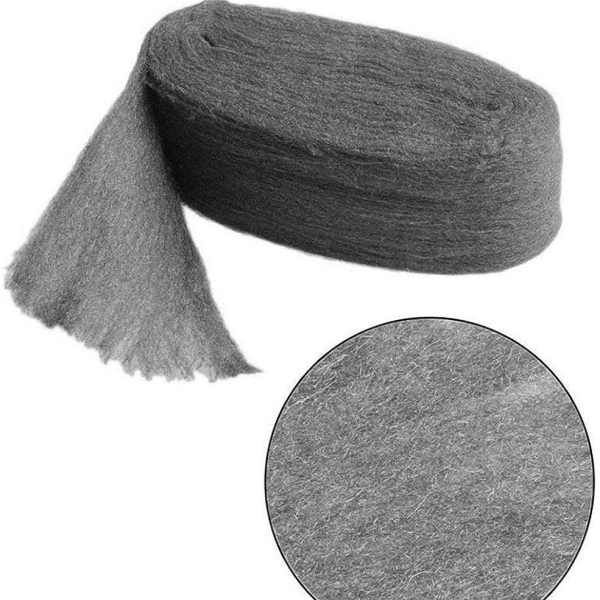
A stainless steel wool pad is a defined piece cut or formed from metallic-fiber material for a specific packing location. It may be rectangular, shaped, layered or prepared to wrap around a perforated core.
The word pad does not define:
For repeat orders, a pad should be identified by a drawing, material specification and target piece weight. A loose piece cut by eye from a roll is not automatically a controlled OEM component.
| Supply Form | What the Supplier Provides | Work Remaining at the Customer |
|---|---|---|
| Stainless steel wool roll or reel | Continuous material in an agreed width, net mass and roll configuration. | Cutting, weighing, forming, placement and part identification. |
| Pre-cut stainless steel wool pad | A defined piece with agreed dimensions and material quantity. | Final placement, wrapping or assembly according to the drawing. |
| Shaped or die-cut wool component | A piece converted to a defined geometry for a particular packing region. | Orientation and assembly into the silencer. |
| Prepared muffler core sleeve | A finished wool-based component with supporting wire cloth or other specified layers. | Fit over the approved core, fastening and complete-silencer assembly. |
A roll offers flexibility for several part numbers. A pad transfers cutting and weight control to the supplier. A prepared sleeve transfers additional forming and containment work. The best choice depends on production volume, model variation and the customer's existing equipment.
Roll and pad quotations are comparable only when they refer to the same approved material.
The specification should identify:
A pre-cut pad made from an unapproved wool grade is not equivalent to an approved roll merely because its dimensions and weight match.
For wider material-selection considerations, review the BSTFLEX guide to stainless steel wool muffler packing for high-temperature exhaust systems.
A stainless steel wool roll should be purchased with values that allow the customer to calculate material usage.
Useful purchasing fields include:
Outside roll diameter should not be used as the only quantity check. Winding compression, reel size and wool structure can change the outside diameter without changing the actual usable mass.
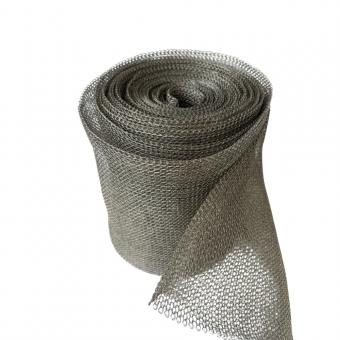
The BSTFLEX Muffler Packing Stainless Steel Wool Reel is the principal product reference for roll-format supply and converted shapes.
When a roll has an approved linear mass:
Piece weight = cut length × wool mass per unit length.
For example only, if a material is specified at 50 g/m and one component requires 0.8 m:
0.8 m × 50 g/m = 40 g per cut piece.
These numbers demonstrate the calculation only. They are not a BSTFLEX standard specification or a recommended muffler packing weight.
Where several strips are used in one silencer:
Total wool charge = weight of one strip × number of strips.
Include overlap and trimming in the approved cut length rather than adding unmeasured material during assembly.
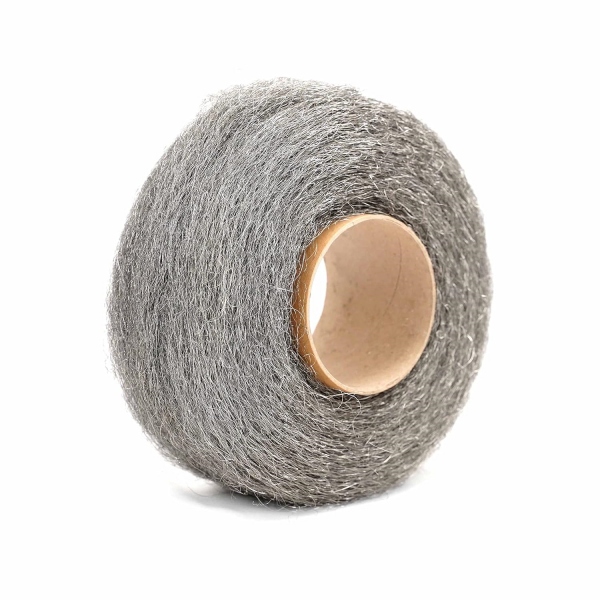
A pre-cut muffler packing pad should have a controlled width, length and target mass.
A pad drawing may specify:
Where the material is cut from a continuous roll, the supplier should know whether the customer needs a rectangular piece, shaped die-cut, layered pad or partially formed wrap.
Do not describe every cut piece as die-cut. Straight knife cutting, rotary cutting, shearing and die cutting are different conversion methods and may produce different edge conditions and tooling requirements.
Stainless steel wool is compressible. A pad can appear thick when relaxed and much thinner after installation.
For repeat supply, define both:
State whether thickness is measured:
Do not compare a relaxed supplier measurement with an installed customer measurement and treat the difference as a product defect.
Roll pricing should be converted into the cost of usable approved pieces.
For a simple one-dimensional cutting plan:
Nominal pieces per roll = usable roll length / approved cut length.
The practical yield may be lower because of:
When shaped pieces are cut from a wide roll, use an area or nesting calculation instead. Record the usable yield rather than assuming all offcuts can be placed into another muffler.
Additional purchasing allowance should remain a production-lot planning value. It is not extra wool to force into each silencer.
Pre-cut pads are worth evaluating when:
The benefit should be measured at the actual production line. Compare material preparation, weighing, assembly, inspection and rework for roll supply and pre-cut supply.
A higher piece price may still reduce total process cost when it eliminates repeated line-side cutting and checking. Conversely, a factory with efficient converting equipment may prefer roll supply.
Roll material may be more practical when:
Roll supply still needs a controlled production instruction. The operator should not decide cut length and material quantity from appearance alone.
A pad is normally a material piece that still needs forming or wrapping. A core sleeve is a more complete component developed around the perforated tube.
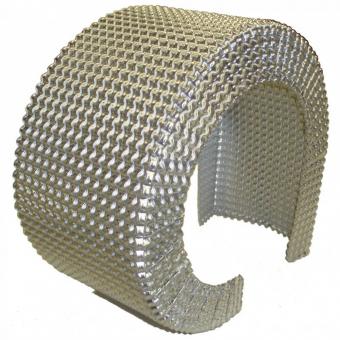
The BSTFLEX Steel Wool Muffler Core Sleeve combines stainless steel wool with supporting stainless steel woven wire cloth. The wire cloth and wool should remain separate material lines in the approved bill of materials.
| Purchasing Question | Pre-Cut Wool Pad | Prepared Core Sleeve |
|---|---|---|
| Is the part already formed around a core diameter? | Usually no. | Yes, according to the approved construction. |
| Is supporting wire cloth included? | Only if explicitly specified. | Included when defined in the sleeve bill of materials. |
| Who controls the final overlap and fastening? | Primarily the customer during assembly. | Shared between supplier component design and customer installation. |
| What should be weighed? | Wool pad mass. | Wool mass and finished sleeve mass where both are controlled. |
| Best fit for | Flexible in-house forming or several related core sizes. | Repeat assembly around a defined core geometry. |
Even a flat pad should be developed from the installed geometry.
Provide:
For a uniform circular core, the minimum geometric wrap length before overlap can be estimated from:
Core circumference = π × outside diameter.
If a wrap layer or supporting cloth changes the effective diameter, use the appropriate installed envelope rather than the bare core diameter.
The final cut length also needs the approved overlap and handling allowance. Do not use the circumference formula alone as the finished production dimension.
More overlap creates more wool in one local region. Multiple layers increase both material quantity and installed thickness.
The drawing should state:
Do not allow each operator to wrap until the component feels sufficiently thick. A controlled piece weight and defined overlap provide a repeatable reference.
Stainless steel wool is often used near the perforated core to help protect surrounding fiberglass or basalt packing. It should not automatically be counted as the full acoustic packing charge.
For a multilayer silencer, identify separately:
If the wool layer becomes thicker or heavier, recheck the remaining space available for the main fibrous filling. Forcing the original fiber charge into a smaller space changes its installed density.
| Inspection Item | Roll or Reel | Pre-Cut Pad |
|---|---|---|
| Material identity | Alloy and approved fiber reference. | Alloy and approved fiber reference. |
| Quantity | Net wool mass, usable width and linear mass or length. | Target piece mass and quantity per package. |
| Dimensions | Roll width and reel configuration. | Finished width, length and shaped profile. |
| Construction | Supplied wool condition and any roll support. | Layering, edge condition and included support materials. |
| Identification | Lot label and roll identification. | Part number, revision, lot and piece-count label. |
| Condition | Packaging damage, contamination and unintended compression. | Damage, missing material, distorted shape or contamination. |
Agree the sampling plan, measurement method and acceptance limits before production orders. Do not create tolerances from a single sample after delivery.
Rolls may be individually wrapped and identified by material lot. Pre-cut pads can be supplied in counted packs, single-component bags or model-specific kits.
Packaging requirements may include:
BSTFLEX discusses customer-specific labels, individual packaging and bulk supply through its OEM Muffler Packing Manufacturing Service.
| RFQ Field | Information to Provide |
|---|---|
| Application | Motorcycle, automotive, ATV, UTV, generator or industrial silencer. |
| Material | Required stainless alloy and wool fiber grade. |
| Supply form | Roll, reel, rectangular pad, shaped pad or prepared core sleeve. |
| Roll requirement | Usable width, net mass, linear mass, core size and packaging. |
| Pad requirement | Width, length, shape, target mass and quantity per silencer. |
| Core geometry | Core OD, covered length, layer count and overlap. |
| Additional materials | Wire cloth, retaining screen, ties or surrounding acoustic packing. |
| Operating conditions | Continuous and peak temperatures with measurement location and duty. |
| Quality requirements | Material documents, inspections, tolerances and lot traceability. |
| Commercial requirement | Prototype quantity, production volume, labels and private packaging. |
No. A pad is normally a cut material piece that still needs forming or placement. A core sleeve is a more complete component designed around a defined tube and may include supporting wire cloth and fastening parts.
Yes, where the material, cutting process, dimensions and piece weights are controlled. Roll supply is appropriate for factories that already have suitable converting and inspection capability.
Both are useful. Weight controls the amount of wool, while thickness and dimensions affect fit and handling. Because wool is compressible, thickness alone should not be used as the material-quantity specification.
Do not assume a direct replacement. Stainless steel wool may serve as a core-side protective layer while fiberglass provides the main acoustic filling. A complete material substitution requires validation of the silencer design.
BSTFLEX can review roll, cut-shape, tube and sleeve requirements for suitable OEM projects. Send the material specification, drawing, piece weight, order quantity and required conversion method for evaluation.
For raw or general-purpose muffler packing material, review BSTFLEX Stainless Steel Wool Exhaust Muffler Packing. For roll-format supply and converted pieces, review the Stainless Steel Wool Reel. For a prepared wool-and-wire-cloth component, review the Steel Wool Muffler Core Sleeve.
Send the alloy, fiber grade, roll or piece dimensions, target wool mass, core geometry and expected order quantity. Other acoustic packing materials and components are available in the BSTFLEX Muffler Packing range.

No.10, Chuangxin North Road, Nanshan Park, Ningguo Economic and Technological Development Zone, Ningguo City, Anhui Province, China
tel/Whatsapp : 0086-15856303740
e-posta : sales@bstbraidedsleeve.com
Skype : vanesa-cheng