ne arıyorsun?
How much expanding exhaust packing do you need? Start with the silencer's approved dry fiber weight, then convert that weight into a sheet area and cut length. When only an approved installed density is available, calculate the usable packing volume first. The fact that a sheet expands with heat does not establish how much fiber belongs in the muffler.
For a rectangular sheet with a known glass-fiber weight per unit area, the quantity calculation is straightforward:
Required sheet length = target dry fiber weight / (usable sheet width × glass-fiber weight per unit area).
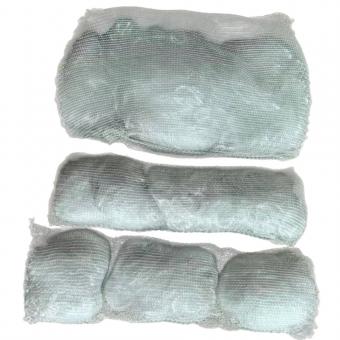
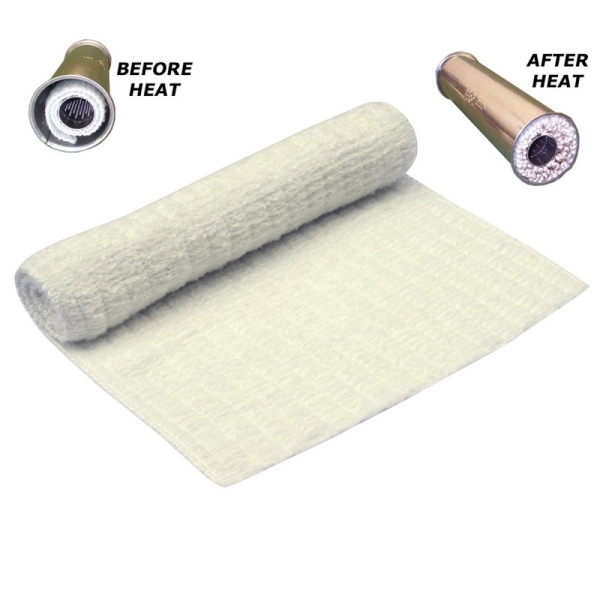
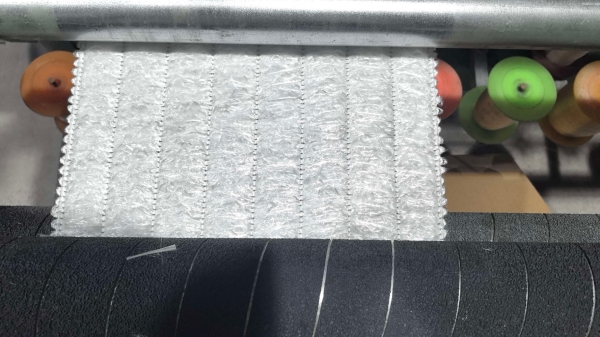
BSTFLEX supplies an expanding exhaust packing sheet made from compressed, texturized continuous-filament glass yarn held by low-melting-point stitching. This guide focuses on converting a silencer specification into a purchasing quantity, cutting dimension and inspection requirement.
A purchase request for "one meter of exhaust packing" leaves two essential details unanswered: how wide is the material, and how much glass fiber does each square meter contain? Without those values, length alone cannot tell you the filling weight.
There are three possible starting points. An existing silencer specification may state a dry fiber mass. Alternatively, it may define an installed density and the volume assigned to that material. For a new design with neither value, the filling quantity must be developed and validated rather than selected from an assumed universal density.
Keep the approved fiber grade with that quantity. A replacement material is not automatically equivalent because it weighs the same. Changes to fiber construction, release behavior or retention layers belong in the sample approval process.
Record the internal shell dimensions, the outside dimensions of the perforated core and the effective length allocated to acoustic packing. Decorative outlet sections, mounting extensions and closed end spaces are not automatically part of the fillable chamber.
Use the actual boundary of the glass-fiber region. Where a metallic core wrap or another layer occupies part of the space, account for its installed envelope. Do not subtract a component twice if it is already included in the boundary dimension.
For exhaust silencer infill in a partitioned body, calculate each packing zone separately. A total volume for the entire shell is not enough when fibers cannot move between compartments.
The following equations provide a manual calculation method. They convert known design inputs into quantities; they do not select an acoustically suitable material or density.
For a constant circular shell surrounding a circular core, with all dimensions entered in millimeters:
V = π × (D2 - d2) × L / 4,000,000.
V is the packing volume in liters. D is the internal diameter of the region available for packing, d is the outside diameter of the core or excluded inner-layer envelope, and L is the effective packed length.
The result assumes that no additional fittings or partitions occupy that space. Subtract their displaced volume where applicable. For a uniform, truly elliptical chamber, use its actual elliptical area; for a flattened oval, tri-oval or other irregular profile, use the drawing or CAD cross-sectional area rather than treating every oval as an ellipse.
An offset core does not change the simple area difference when it remains fully inside the same shell, but it does change local clearances. Check the narrow and wide packing regions independently during assembly validation.
When the design specifies density in grams per liter:
Dry fiber weight in grams = net packing volume in liters × approved installed density in g/L.
The units g/L and kg/m3 have the same numerical value. However, a sheet's areal weight in g/m2 is a different measurement and cannot be substituted for installed density.
A muffler packing density value should refer to the defined fiber charge and its allocated volume. Do not include the mass of a stainless steel liner, retaining screen or shipping bag in the glass-fiber charge.
Use the following units for a rectangular cut piece:
Cut length in meters = dry fiber weight in grams / (sheet width in meters × glass-fiber areal weight in g/m2).
Use the width that will actually remain in the finished piece, not the wider purchased width before edge trimming. Confirm whether the supplier's stated areal weight covers glass fiber alone or the complete stitched sheet. The calculation and the target weight must use the same material basis.
The following numbers are hypothetical calculation inputs. They are not BSTFLEX stock specifications, recommended packing densities or test results. Assume that an example silencer program has already approved a 300 g dry glass-fiber charge for the material under evaluation.
| Example Input | Assumed Value |
|---|---|
| Internal diameter of packing chamber | 120 mm |
| Outside diameter of core, with no separate inner liner in this example | 50 mm |
| Effective packed length | 400 mm |
| Previously approved dry glass-fiber charge | 300 g |
| Usable sheet width | 400 mm, or 0.40 m |
| Glass-fiber areal weight, excluding temporary stitching | 750 g/m2 |
Volume: π × (1202 - 502) × 400 / 4,000,000 = approximately 3.738 liters.
Average installed fiber density: 300 / 3.7385 = approximately 80.25 g/L. This is a calculated consequence of the assumed fiber charge, not a recommended density.
Cut length: 300 / (0.40 × 750) = 1.00 meter.
The calculated material quantity is therefore a 400 × 1000 mm cut piece containing 300 g of glass fiber. The cutting layout must still suit the stitching, installation route and chamber geometry. This calculation alone does not demonstrate that the compact piece fits or that its released fibers distribute correctly.
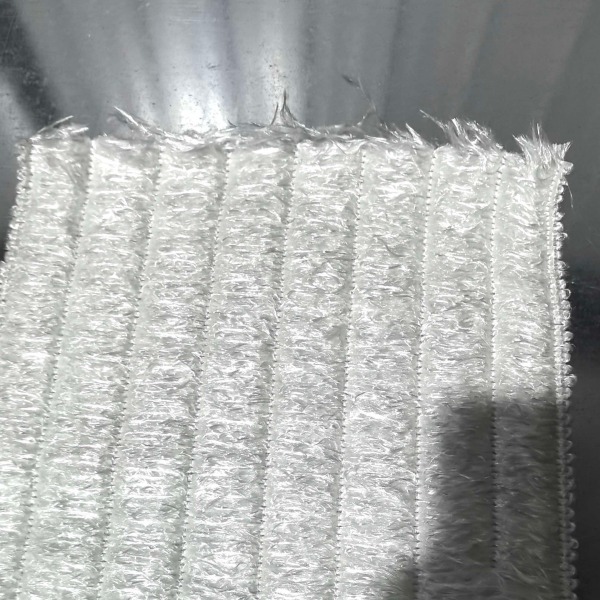
A muffler packing sheet sold as 400 × 1000 mm has an area of 0.40 m2. Its fiber weight depends on the material's areal weight. The following arithmetic examples show why package dimensions are not a complete specification.
| Illustrative Sheet | Assumed Glass-Fiber Areal Weight | Glass Fiber in a 400 × 1000 mm Piece |
|---|---|---|
| A | 500 g/m2 | 200 g |
| B | 750 g/m2 | 300 g |
| C | 1000 g/m2 | 400 g |
These are not three recommended substitutes. They demonstrate that equal area does not mean equal fiber quantity. Compare fiber construction, release characteristics and installed results as well as weight when assessing another supplier's fiberglass silencer wadding.
Numbers such as 350, 400, 450 and 500 mm may describe sheet width, packed length or another product dimension. Identify the direction on the cutting drawing rather than relying on a size label alone.
In a wrapping layout where sheet width runs along the core, that width must match the effective acoustic section and specified end clearances. The length taken around the core is then determined from the required material quantity and approved arrangement.
Buying a wider exhaust packing sheet and trimming it down changes the usable area and fiber weight. Calculate the installed quantity after trimming. Do not retain the original package weight as the assumed muffler filling weight.
Similarly, do not rotate a cut piece solely because the dimensions appear to fit. Check the permitted cutting orientation, stitching arrangement and installation method for the supplied construction.
Self expanding muffler packing releases a restrained fiber structure; it does not generate additional glass fiber. An expansion figure needs defined starting compression, heating conditions and measurement conditions before it can be interpreted.
A free-expansion volume measured outside the shell is not the same as the space occupied inside a confined muffler. Dividing the chamber volume by a general expansion multiplier is therefore not a reliable substitute for an approved filling specification.
For continuous filament exhaust packing, use the selected fiber grade, specified charge and agreed conditioning procedure as the development reference. Inspect distribution after release, especially around offset cores and restricted end spaces.
Separate the material purchased for a production lot from the material installed in each accepted muffler. Additional purchasing allowance may be needed for edge trimming, setup pieces or rejected cuts. That allowance is not extra packing to force into every shell.
For a fixed-width cutting process:
Net production length = number of silencers × approved cut length per silencer.
Required purchased length = net production length / expected usable yield.
Express yield as a decimal fraction established from the actual cutting process or an agreed planning basis. Where width nesting or irregular cutting patterns are involved, use an area-based cutting plan instead of this simple length calculation.
When comparing exhaust packing by the metre with pre cut exhaust packing sheets, include the cost of unusable offcuts, weighing, preparation and inspection. Compare both options against the same approved fiber quantity per silencer.
For custom cut muffler packing, put the fiber identification, sheet areal weight, cut dimensions and target dry filling weight on the approved record. Define whether weight limits apply to the glass fiber or the complete stitched component.
State how the piece is oriented and which trimming or fastening operations are permitted. Agree the acceptance limits instead of assuming a general tolerance for all materials and cutting methods.
For incoming inspection, confirm the material reference and measured cut-piece weight using the agreed mass basis. An unused approved sample is a better dimensional and construction reference than removed packing whose weight may have changed through fiber loss or contamination.
Validate the assembled silencer after the specified release cycle and operating trial. Correct arithmetic establishes a controlled input, not a guaranteed sound level or service interval.
Not necessarily. One meter only defines length. You also need the usable width, glass-fiber areal weight and approved filling quantity for the actual silencer. A matching package length does not establish suitability.
The combined fiber mass can be calculated, but the revised joints, overlaps and placement still require review. Matching the weight does not prove that a different cutting layout will distribute the packing in the same way.
Only when the respective silencer specifications support that choice. Engine cycle is not a substitute for chamber dimensions, material grade, operating conditions or a validated filling charge.
Send the internal geometry, application, existing material information and any original drawing or sample. These provide a starting point for reviewing a proposed construction. The final filling weight should be agreed through the appropriate development and approval process.
For OEM exhaust packing sheets, send the silencer cross-section, core outside dimensions, shell internal profile and effective packed length. Add the current fiber specification, approved dry weight or density where available, and the intended cutting and assembly method.
Include sample and production quantities, material identification requirements and packaging preferences. Temperature information should identify the measurement location and distinguish normal service from short peaks.
Use the BSTFLEX expanding muffler packing sheet as the product starting point. Drawing-based development and repeat-order requirements can be discussed through our custom muffler packing manufacturing service. Other forms are available in the muffler packing product range.
Send Your Silencer Dimensions and Request an Expanding Exhaust Packing Quote

No.10, Chuangxin North Road, Nanshan Park, Ningguo Economic and Technological Development Zone, Ningguo City, Anhui Province, China
tel/Whatsapp : 0086-15856303740
e-posta : sales@bstbraidedsleeve.com
Skype : vanesa-cheng